Wednesday, November 14, 2012

Early results are in: the twins are thriving in the same classroom.

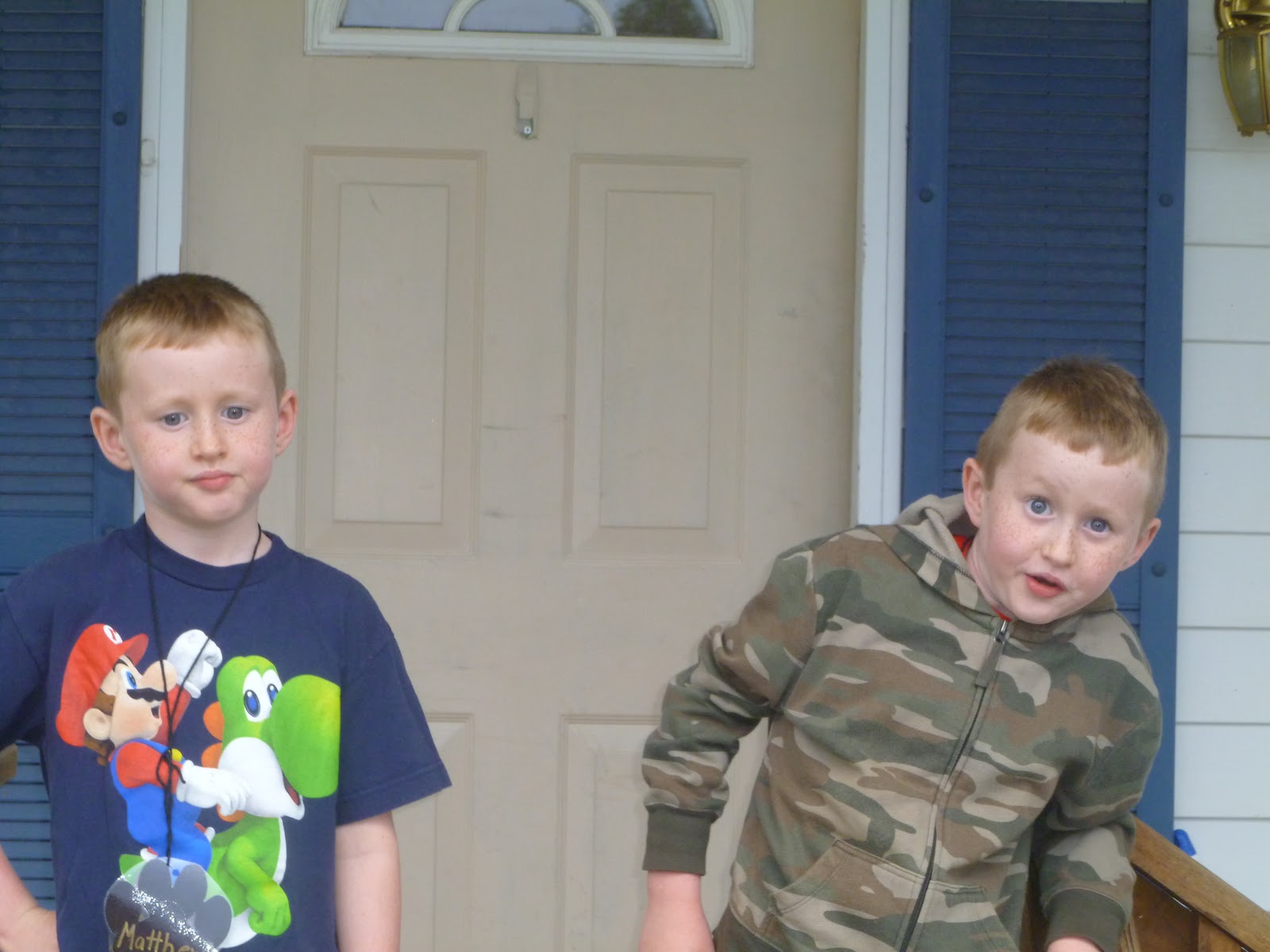
Jonathan in blue, Matthew in red
Last week, I had our first conference with Matthew and Jonathan's kindergarten teacher.
So far, so good.
Their teacher admitted he was hesitant when he learned we had requested that they be in the same classroom and, for those first few days, there were some issues. Mostly, he said, Jonathan and Matthew had to learn they could not get physical with each other in school - no poking or prodding allowed.
But now, he said, "they're just like any two kids in the classroom. When there are issues, they are just boy issues -- boys being boys." 
He no longer even relies on clothing to tell them apart.
Their report cards were not identical, but they were very similar. In the few areas where they differed academically, personality had a strong influence. For instance, Matthew's report card showed he could count only to 30 while Jonathan's showed a limit of 100.
Matthew has been counting to 100 since he was three. It's always been a game for him and his twin brother, counting in the back seat as we drove. They also learned to count by tens at an early age. So I know he knows this stuff.
But while Jonathan sees any kind of testing as a challenge, Matthew finds it annoying. He is is easily bored with reading aloud, counting and any other form of quizzing, preferring to deny knowledge so he can move on to more active pursuits. 
Homework with him is already a struggle.
Emotionally and socially, I saw the personality differences that have always been apparent reflected. Jonathan wears his emotions tattooed prominently across his forehead. When is angry, he is very angry. When he is sad, he is a blubbering ball of emotions.
Matthew has greater control and, though this was not on the report card, he certainly knows how to push his twin's buttons. He is emotional as well, but he is more covert -- just slightly less likely to lose his cool. 
Each has his own friends and a few shared ones, though they claim they are often picked on by the same girl. Our oldest daughter complains she can rarely sit with them at lunch. They usually sit at separate tables and she doesn't want to choose one over the other.
Gym class worried me the most though.
The boys are highly competitive and they can become physically abusive to each other when they argue over games or races. But their gym teacher assured me they rarely even communicate in her class. Each goes off with his own his own group and does his own thing.
Their issues in gym are more typical of their development as individuals. In the beginning, they would each get upset it they did not get the color of their choice, or if they did not get a turn. That has improved, she said, more so with one twin making bigger strides than the other (Guess who!).
A few days after the conference, I asked Matthew and Jonathan whether they enjoy being together in school and whether they might want to stay together next year.
Normally, Jonathan would begin to tear up at the thought of any separation that lasts more than a few hours, and Matthew would pounce on that, insisting they each go their own way just to a reaction. We know this because if we actually try separating them, Matthew is the first to break down.
This time, however, Matthew was the first to react positively, nodding his head vigorously.
"I want to be with my brother," he said.
"Yeah," Jonathan said, smiling. "Me too."  

Thursday, October 18, 2012

Thanks to identical twins, we might be able to detect breast cancer before it even develops

Scientists practically drool over identical twins and their shared DNA, especially when one twin develops a major, and possibly genetically related illness, and the other does not. Identical twins can help unlock medical mysteries that might otherwise go unsolved.
The results of a recent study on breast cancer can help the rest of us appreciate the scientific fever over identical twins and their potential contributions.
This is a big one.
The study -- led by Manel Esteller, director of the Cancer Epigenetics and Biology Program at the Bellvitge Biomedical Research Institute (IDIBELL), Professor of Genetics at the University of Barcelona and ICREA researcher -- has helped researchers identify a genetic change that occurs in those who will later develop breast cancer.
This information could lead to new blood tests that help doctors identify breast cancer victims long before their cancers actually develop. It could lead to new drugs that more efficiently target tumors and that prevent breast cancer in the first place.
It all goes back to epigenetics.
All DNA is influenced by environment.
Chemical signals received by DNA can trigger certain changes, turning genes off and on like a light switch. That's the theory behind epigenetics. It's why some pairs of identical twins have clear physical differences, like height or moles or head shape. It explains lower immunity in one twin than in another. It shows why some will develop certain genetic diseases while their twins do not.
In this case, researchers found that twins with breast cancer had "a pathological gain of methylation in the DOK7 gene" years before their cancer was clinically diagnosed, according to Dr Esteller in an article on the institute's website.
The next step for the researchers will be knowing the exact function of the DOK7 gene. "We believe it is a regulator of tyrosine kinases, an antitumor drug target already used for the treatment of breast cancer. If DOK7 performs this function, new studies to test drugs with tumour chemopreventive effects in breast cancer could be planned in the future," he concludes.
In simpler terms, scientists believe that particular gene is a regulator of a drug already used to fight tumors. If that proves true, the information could lead to big changes in the way we diagnose, treat and prevent breast cancer.  A simple blood test could tell women (And men. Let's not forget they can have breast cancer too.) whether they will develop the disease in the near future.
All thanks to 36 sets of selfless identical twins.

Friday, September 28, 2012

My towering twins

Silly me.
I had worried that Matthew and Jonathon would be labeled by their shared DNA in school.
But does anyone say, "Hey, are you the mom of the identical twins?"
No.
They say, "Hey, you're the mom of the tall twins, aren't you?"
Yes, Jonathan and Matthew have a greater claim to fame. They are off the charts for height, just like their older brother and sister, and thanks, probably, to their six-foot-five dad.
I haven't measured them since July, but they were 50 inches tall then.
At five years old, that puts them in the highest category, according the National Centers for Disease Control: "above the 95th percentile."
Their height has always been a problem.
(They are precisely the same height, a sore subject between them.)
Public tantrums were bad when they were three years old, especially since they fed off each other. But they were made worse by people who assumed they were two years older.
Once, a woman who saw one twin melting down in typical 3-year-old fashion as we passed the grocery store's chip selection -- a total stranger -- told me I should beat him because he was too old to behave that way.
(I suggested that perhaps the same discipline would be appropriate for her -- the one and only time I ever managed a good comeback in the heat of the moment.)
Several times when we visited the mall on their day off from preschool, some older woman (why the older women?) or a store clerk would demand to know (not "ask," but "demand") why they weren't in school.
I admit I took pleasure in watching their nosy jaws drop when I'd say they were only four.
So I knew they were taller than average and I knew their height might someday be an issue.
But, honestly, I didn't realize the difference was that great.
Few people said anything when they were in preschool.
But the private preschool they attended two days a week was small and two other boys were not far behind them in height. The public preschool, where they now attend kindergarten, had a much larger class, but the kids were tucked away on one end of the building, at least during the two days the twins attended.
Few people outside the preschool ever saw them.
Not so any more.
Now they are in the hallways, on the playground and in the cafeteria with the rest of the elementary school crowd.
Their little (still "little" to me) heads shoot up above their classmates, more on level with the first- and second-graders than with their peers.
It might not seem like a handicap.
People tend to reserve that stereotype for shortness.
But it is.
Even when people know how old they are, it's hard to conceive. They subconsciously raise their expectations ... just like I do ... just like I have always done to their older brother and sister, despite my best efforts.
Once again though, their twinness comes to the rescue.
Rarely do they care what others think.
They have that confidence -- that impenetrable space between them -- that they derive from each other.
They are, as they might say, "cool with it."

Friday, September 7, 2012

They are all yours, class of 2025!

Three days ago, Matthew and Jonathan started their new careers.
They are officially kindergartners.
And with their launch into the academic world has come a renewed round of the infamous question, "Are they in the same classroom?" My response ("Yes, they are.") elicits everything from raised eyebrows to pleased smiles to spontaneous lectures.
I tell them the same things I have written in this blog over the past several years.
Our decision was based on recent research, conversations with identical twins and talks with teachers who have experience with twins who were placed in the same classrooms.
We have the confidence that we have made the right decision, and we have the intelligence to let time, experience and Jonathan and Matthew's wishes be our guide for the future.
But, in New York State, where parents are not guaranteed a say in the placement of multiples, all the research in the world would have been irrelevant without the cooperation of an open-minded principal. Our principal has never experienced twins in the same classroom. Yet, he was fascinated by the studies we presented him and eager to do what is best for Matthew and Jonathan.
So he readily agreed.
He will be watching their social and academic progress as closely as we will.
None of those concerns matter, however, to the boys.
They are already having a blast and each has attached himself to a different "best friend."
For the past two days, I have had to drag them out the classroom at the end of the day.
My arms are weakening.
I'm thinking about lining the route from the classroom to the van with freeze pops and Smarties, two of their favorite treats, to get them home.
Here are a few photos from the first day.


(Note: Jonathan is wearing a jacket despite the heat because "that's what you wear to school.")


Sunday, August 26, 2012

The twins are ready for kindergarten, but am I?

On September 5, Matthew and Jonathan will start kindergarten.
They will be in the same classroom at our request and with the principal's blessing.
He is as eager to observe the results as we are.
I am nervous.
I admit it.
But it's not about the shared classroom.
I had always thought I'd be excited for this moment, for the moment when all four kids were in school full-time together. Same hours, same days, same vacations.
One drop-off. One pick-up.
It was my dream.
How hard could it be, I thought.
After all, the twins were in preschool four days a week last year and I was fine with that.
Neither was I upset when the older kids started full-day school years ago.
But it's that fifth day that bothers me, the day I had alone with the twins.
And it's those vacation days from public school that are eating away at me, the days the twins attended their private preschool and I had time alone with their older brother and sister.
Those were the days we could do things that were more age-specific, things the kids could enjoy more without their older or younger siblings. Those were the days when I could let go of a little mommy-guilt and feel like I was doing as much for my children as I did when we had only two.
I'm sure I will still get time alone with each set of kids, but I'll have to work at it. Someone else -- probably my husband -- will have to spend time with the other two children. That limits our outings to weekends and evenings, reduces the spontaneity and limits the time we can spend together as a full family - my husband, all four kids and me.
It will also make it even harder to spend alone-time with the kids individually.
I grew up in a family of eight kids.
Alone-time with our parents was pretty much unheard of.
I didn't suffer and I'm sure our kids won't either.
Intellectually, I know that.
But that doesn't make it any easier, especially in a society that insists alone time is so important for identical twins.
My husband and I already know that separation in the classroom does not equal individuality. What works is simply treating kids like individuals - all kids whether they are identical twins or whether they are a boy and a girl born 17 months apart.
So I guess that's what I'll have to work on most.
I'll have to work harder on treating all four kids like individuals when they are together.
I can do that, right?

Thursday, July 19, 2012

The evidence is in: differentiation in identical siblings begins before birth

The medical community has finally confirmed something most all parents of identical twins have always known: Our twins do not emerge from the womb purely identical. Differentiation begins when the egg splits and continues throughout their lifetimes.
Identical twins share the same DNA.
This new study does not dispute that.
Rather, the explanation for the differences lies in epigenetics, the way identical genes that accompany that shared DNA express themselves. Genes, scientists have learned, can be turned on and off like light switches. Those switches are flipped by environmental influences.
Epigenetics explains why identical twins can look somewhat different and have different inheritable diseases and conditions despite their common DNA.
I see it in my own guys.
At 5 years old, Matthew and Jonathan are precisely the same height. Their hands and feet are the same sizes and their hair grows in all the same directions. Yet, one is slighter than the other, overall. One has a higher-pitched voice. One has a spider vein on his face.
They have different tastes in food and different levels of immunity.
They are daring in different ways; shy in different ways.
They are very much identical, but they are different.
Before we had Jonathan and Matthew DNA tested, when they were still infants, so many people looked for those minute differences as proof that they were fraternal. Identical twins, especially infants, should be identical in every way, they believed.
It was annoying.
Some of those people were relentless.

Scientists had already proven such changes take place after birth, but researchers from Murdoch Children’s Research Institute (MCRI) in Melbourne are the first to prove the environment in utero can also be responsible for such changes.
The Australian scientists used cord blood, placentas and umbilical cords collected at birth from both identical and nonidentical twins to prove their theories, according to recent article in the Deccan Herald. They found that although identical twins share the same DNA sequence, the chemical markers that switch genes on and off are different.
That makes sense to me.
In that first ultrasound at 20 weeks, the day we learned I was carrying twins, Matthew was already set to escape. He had claimed the spot at the bottom of my uterus near the cervix, the head-down position usually reserved for a baby who is prepared to make an exit.
There he remained until delivery.
Jonathan seemed to spend the whole pregnancy trying to get comfortable. He was in breech position at delivery after flipping head-up and head-down a few times during the last weeks of pregnancy (That hurts, by the way!). When Matthew cleared out his space, Jonathan spent the next 20 minutes swimming, alluding the grip of my OB.
He became a c-section baby when he decided to take a pike dive -- head and foot first -- into the world.
Their experiences in utero were entirely different.
Why wouldn't that change them?
What does that mean for identical siblings? For parents of identical siblings?
It's hard to say.
The research team believes it might help track and treat diseases earlier in life. I'm not so sure about that. I can't imagine pediatricians will suddenly start testing the cord blood of all newborns for changes in chemical markers. It's not practical.
Their team leader also noted that it might help parents understand that certain elements of fetal development are out of the parents' control. That could be comforting for some. Disconcerting for others.

For me, personally, it's a scientific answer to questions I get all the time: how can Matthew and Jonathan have physical difference and still be considered identical? It's a scientific answer for all those parents who ask on online forums how their twins might possibly be identical when their birth weights are so drastically different or they are different heights.
It's a scientific answer to support what should be common sense.
No two people will ever be precisely alike.

Wednesday, June 20, 2012

Preschoolers no more!

Jonathan and Matthew are on their way to kindergarten!
They were ecstatic as they graduated preschool this week and last -- first from their private school and then from the public school. My camera battery died minutes into the first graduation, so this photo bomb is limited to the second graduation.


Matthew is on the left and Jonathan is on the right. Both were so excited that they insisted on leaving for the school right after these photos, half an hour early. Though the differences in their haircuts are slight, Jonathan's longer style seems to bring out the fullness in his face more. They were the tallest in both of their preschools at 4-foot-2.


Jonathan won the award for best at puzzles. He told his teachers he wants to be a pizza guy when he grows up.


Matthew wants to drive trains when he grows up, according to his teachers. He won the award for best at computers.


The public preschool, which is run by the local Head Start program, does detailed evaluations of the children a few times a year for academic, social, emotional and physical development (motor skills). Jonathan and Matthew scored identically on each evaluation with the exception of an occasional missed letter sound or number. By the final evaluation, their reports were entirely identical.


In each of the preschools, Matthew and Jonathan had their own best friends. Those friendships were harder to forge in the public preschool, which they attended only two days a week as non-district residents. The other children all attended five days a week and had strong bonds, forcing Jonathan and Matthew together more often. (There were many more part-timers in their private preschool.) By the end of the school year, the teachers told us they were separating more regularly and developing healthy friendships. 


Just before this picture, we learned the identity of their kindergarten teacher and spent some time nosing around his classroom. The twins quizzed him endlessly and he held up well under their fire. We could not have gone wrong with either teacher, but seeing that classroom and knowing he will be their teacher seemed to make it all the more real to them.

They are preschoolers no more!