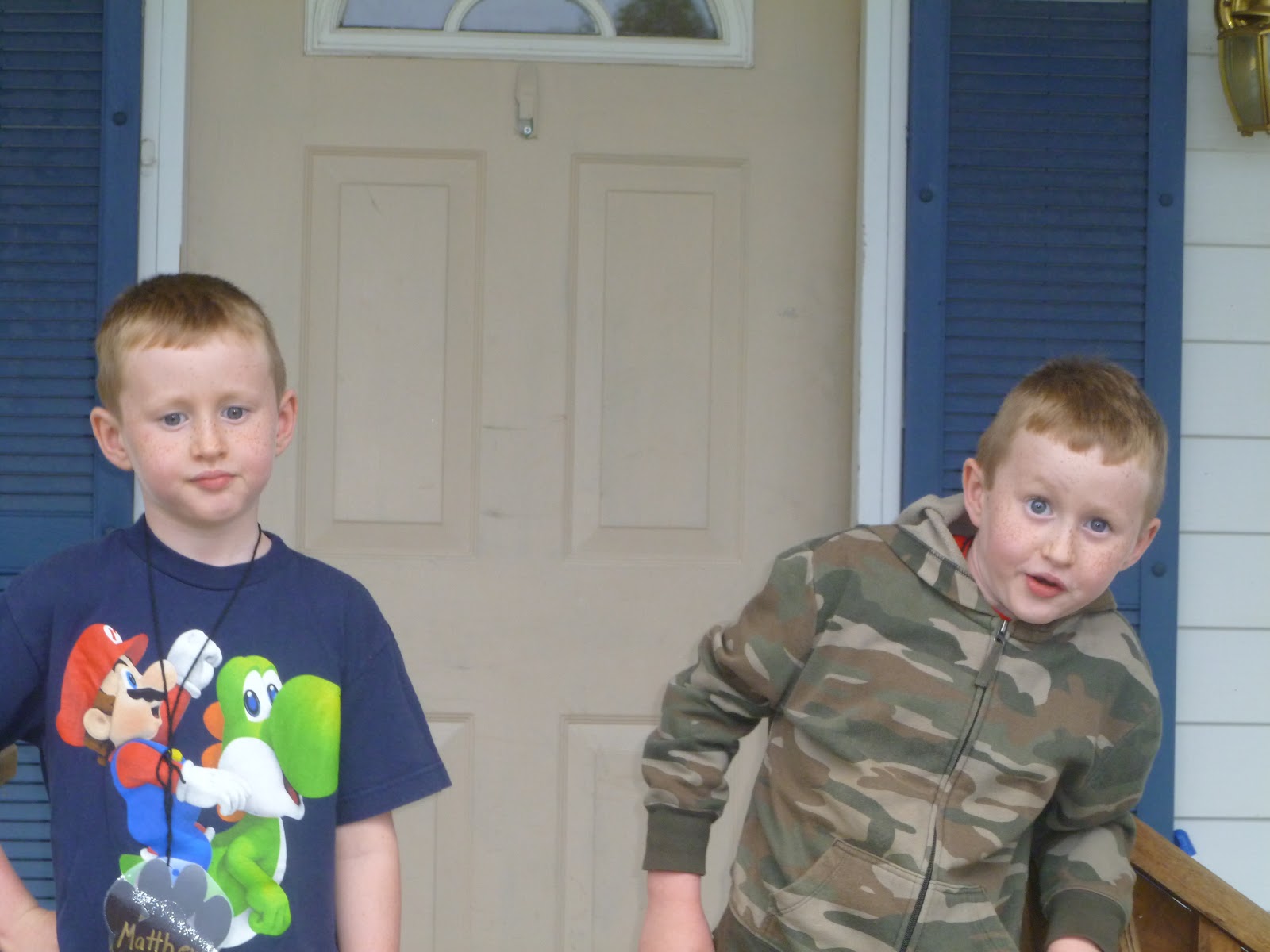
Matthew and Jonathan have an odd dynamic when they deal with issues of frustration and anger, and I wonder whether we're alone in this.
The boys are getting older -- they will be six in eight days -- so I will not apply names to their specific behaviors. I feel I need to change the way I write about them as they age to protect their privacy in ways that will matter to them in the future.
But here's how it works.
One twin has a harder time than the other dealing with losing or not achieving his goals.
He gets mad.
Boy does he get mad!
He yells and stomps and hollers and, if some unfortunate Wii remote or game piece happens to be in his hands, he throws it. But he rarely hurts people. His anger is directed at himself and the particular challenge.
As we struggle to deal with this -- giving time-outs, talking with him, refusing to play with him unless he calms down, prohibiting certain trigger games for a while, offering him de-stressing techniques, tearing out what remains of our hair, gulping that glass of wine -- we face another obstacle.
A 60-pound, four-foot-four obstacle.
The other twin instantly reacts to his brother's emotions by hitting him or pinching him as hard as he can. If we're not in the room, it turns into an all-out brawl.
The offending twin doesn't know why he does this and can't seem to stop himself.
It could be because he knows his brother's behaviors will bring an end to the fun, and we've tried addressing that. We've tried continuing the activity with the other twin (after a time-out for hurting his brother, of course), but he does this even if he's not been involved in the activity.
So I'm wondering whether it really has to do with their immediate and obvious impact on each other or whether it's like their other empathic reactions -- they way they each get upset when the other is sad, or plead for the release of the twin who is in time-out, or refuse to sleep in our bed when they wake during the night for fear of leaving the other twin alone.
Maybe the one twin just can't stand the strength of his brother's emotions, so his tries to stop him for his own sake the only way he knows how. He reacts this way during play dates, but not when his brother melts down in school.
Instead, he steps back in school, away from the staff and other students who are trying to calm his brother down. My guess is that he controls himself because of the environment. We tend to let loose among those who love us unconditionally, like mom and dad.
We are working with the twin who has trouble losing. He is making progress, very slow progress at home and a little more progress at school, but nothing we do alters the reaction of his brother.
Still, in the midst of chaos -- flying Wii remotes, pinching fingers and time-outs -- I find myself intrigued, wondering what inspires him to do this.
Why can't the one twin allow his brother to experience frustration on his own?
Why can't he just let him be angry?
I'm baffled.
Showing posts with label twins. Show all posts
Showing posts with label twins. Show all posts
Thursday, January 10, 2013

Friday, December 21, 2012
Happy holidays!
"I remember you two," Santa exclaimed when Matthew and Jonathan climbed on his lap at our local mall a few weeks ago.
How could he forget?
Last year, the boys lured him into the center court so they could point out the Pillow Pets they wanted in a nearby kiosk.
As their sixth birthday approaches, Jonathan and Matthew remain Santa obsessed.
Here are photos taken with three different Santas this year (Some are Santa's helpers, of course! Matthew and Jonathan pulled a few beards trying to distinguish the real thing from the stand-ins.).
Happy holidays from our home to yours!
How could he forget?
Last year, the boys lured him into the center court so they could point out the Pillow Pets they wanted in a nearby kiosk.
As their sixth birthday approaches, Jonathan and Matthew remain Santa obsessed.
Here are photos taken with three different Santas this year (Some are Santa's helpers, of course! Matthew and Jonathan pulled a few beards trying to distinguish the real thing from the stand-ins.).
Happy holidays from our home to yours!
 |
| Jon on the left, and Matt on the right at the mall. |
 |
| Matthew at the local community center |
 |
| Jonathan at the local community center |
 |
| Matthew on the left and Jonathan on the right in Corning, N.Y. |
Wednesday, November 14, 2012
Early results are in: the twins are thriving in the same classroom.
 |
| Jonathan in blue, Matthew in red |
So far, so good.
Their teacher admitted he was hesitant when he learned we had requested that they be in the same classroom and, for those first few days, there were some issues. Mostly, he said, Jonathan and Matthew had to learn they could not get physical with each other in school - no poking or prodding allowed.
But now, he said, "they're just like any two kids in the classroom. When there are issues, they are just boy issues -- boys being boys."
He no longer even relies on clothing to tell them apart.
Their report cards were not identical, but they were very similar. In the few areas where they differed academically, personality had a strong influence. For instance, Matthew's report card showed he could count only to 30 while Jonathan's showed a limit of 100.
Matthew has been counting to 100 since he was three. It's always been a game for him and his twin brother, counting in the back seat as we drove. They also learned to count by tens at an early age. So I know he knows this stuff.
But while Jonathan sees any kind of testing as a challenge, Matthew finds it annoying. He is is easily bored with reading aloud, counting and any other form of quizzing, preferring to deny knowledge so he can move on to more active pursuits.
Homework with him is already a struggle.
Emotionally and socially, I saw the personality differences that have always been apparent reflected. Jonathan wears his emotions tattooed prominently across his forehead. When is angry, he is very angry. When he is sad, he is a blubbering ball of emotions.
Matthew has greater control and, though this was not on the report card, he certainly knows how to push his twin's buttons. He is emotional as well, but he is more covert -- just slightly less likely to lose his cool.
Each has his own friends and a few shared ones, though they claim they are often picked on by the same girl. Our oldest daughter complains she can rarely sit with them at lunch. They usually sit at separate tables and she doesn't want to choose one over the other.
Gym class worried me the most though.
The boys are highly competitive and they can become physically abusive to each other when they argue over games or races. But their gym teacher assured me they rarely even communicate in her class. Each goes off with his own his own group and does his own thing.
Their issues in gym are more typical of their development as individuals. In the beginning, they would each get upset it they did not get the color of their choice, or if they did not get a turn. That has improved, she said, more so with one twin making bigger strides than the other (Guess who!).
A few days after the conference, I asked Matthew and Jonathan whether they enjoy being together in school and whether they might want to stay together next year.
Normally, Jonathan would begin to tear up at the thought of any separation that lasts more than a few hours, and Matthew would pounce on that, insisting they each go their own way just to a reaction. We know this because if we actually try separating them, Matthew is the first to break down.
This time, however, Matthew was the first to react positively, nodding his head vigorously.
"I want to be with my brother," he said.
"Yeah," Jonathan said, smiling. "Me too."
Thursday, October 18, 2012
Thanks to identical twins, we might be able to detect breast cancer before it even develops
Scientists practically drool over identical twins and their shared DNA, especially when one twin develops a major, and possibly genetically related illness, and the other does not. Identical twins can help unlock medical mysteries that might otherwise go unsolved.
The results of a recent study on breast cancer can help the rest of us appreciate the scientific fever over identical twins and their potential contributions.
This is a big one.
The study -- led by Manel Esteller, director of the Cancer Epigenetics and Biology Program at the Bellvitge Biomedical Research Institute (IDIBELL), Professor of Genetics at the University of Barcelona and ICREA researcher -- has helped researchers identify a genetic change that occurs in those who will later develop breast cancer.
This information could lead to new blood tests that help doctors identify breast cancer victims long before their cancers actually develop. It could lead to new drugs that more efficiently target tumors and that prevent breast cancer in the first place.
It all goes back to epigenetics.
All DNA is influenced by environment.
Chemical signals received by DNA can trigger certain changes, turning genes off and on like a light switch. That's the theory behind epigenetics. It's why some pairs of identical twins have clear physical differences, like height or moles or head shape. It explains lower immunity in one twin than in another. It shows why some will develop certain genetic diseases while their twins do not.
In this case, researchers found that twins with breast cancer had "a pathological gain of methylation in the DOK7 gene" years before their cancer was clinically diagnosed, according to Dr Esteller in an article on the institute's website.
All thanks to 36 sets of selfless identical twins.
The results of a recent study on breast cancer can help the rest of us appreciate the scientific fever over identical twins and their potential contributions.
This is a big one.
The study -- led by Manel Esteller, director of the Cancer Epigenetics and Biology Program at the Bellvitge Biomedical Research Institute (IDIBELL), Professor of Genetics at the University of Barcelona and ICREA researcher -- has helped researchers identify a genetic change that occurs in those who will later develop breast cancer.
This information could lead to new blood tests that help doctors identify breast cancer victims long before their cancers actually develop. It could lead to new drugs that more efficiently target tumors and that prevent breast cancer in the first place.
It all goes back to epigenetics.
All DNA is influenced by environment.
Chemical signals received by DNA can trigger certain changes, turning genes off and on like a light switch. That's the theory behind epigenetics. It's why some pairs of identical twins have clear physical differences, like height or moles or head shape. It explains lower immunity in one twin than in another. It shows why some will develop certain genetic diseases while their twins do not.
In this case, researchers found that twins with breast cancer had "a pathological gain of methylation in the DOK7 gene" years before their cancer was clinically diagnosed, according to Dr Esteller in an article on the institute's website.
The next step for the
researchers will be knowing the exact function of the DOK7 gene. "We believe it
is a regulator of tyrosine kinases, an antitumor drug target already used for
the treatment of breast cancer. If DOK7 performs this function, new studies to
test drugs with tumour chemopreventive effects in breast cancer could be planned
in the future," he concludes.
In simpler terms, scientists believe that particular gene is a regulator of a drug already used to fight tumors. If that proves true, the information could lead to big changes in the way we diagnose, treat and prevent breast cancer. A simple blood test could tell women (And men. Let's not forget they can have breast cancer too.) whether they will develop the disease in the near future.All thanks to 36 sets of selfless identical twins.
Friday, September 28, 2012
My towering twins
Silly me.
I had worried that Matthew and Jonathon would be labeled by their shared DNA in school.
But does anyone say, "Hey, are you the mom of the identical twins?"
No.
They say, "Hey, you're the mom of the tall twins, aren't you?"
Yes, Jonathan and Matthew have a greater claim to fame. They are off the charts for height, just like their older brother and sister, and thanks, probably, to their six-foot-five dad.
I haven't measured them since July, but they were 50 inches tall then.
At five years old, that puts them in the highest category, according the National Centers for Disease Control: "above the 95th percentile."
Their height has always been a problem.
(They are precisely the same height, a sore subject between them.)
Public tantrums were bad when they were three years old, especially since they fed off each other. But they were made worse by people who assumed they were two years older.
Once, a woman who saw one twin melting down in typical 3-year-old fashion as we passed the grocery store's chip selection -- a total stranger -- told me I should beat him because he was too old to behave that way.
(I suggested that perhaps the same discipline would be appropriate for her -- the one and only time I ever managed a good comeback in the heat of the moment.)
Several times when we visited the mall on their day off from preschool, some older woman (why the older women?) or a store clerk would demand to know (not "ask," but "demand") why they weren't in school.
I admit I took pleasure in watching their nosy jaws drop when I'd say they were only four.
So I knew they were taller than average and I knew their height might someday be an issue.
But, honestly, I didn't realize the difference was that great.
Few people said anything when they were in preschool.
But the private preschool they attended two days a week was small and two other boys were not far behind them in height. The public preschool, where they now attend kindergarten, had a much larger class, but the kids were tucked away on one end of the building, at least during the two days the twins attended.
Few people outside the preschool ever saw them.
Not so any more.
Now they are in the hallways, on the playground and in the cafeteria with the rest of the elementary school crowd.
Their little (still "little" to me) heads shoot up above their classmates, more on level with the first- and second-graders than with their peers.
It might not seem like a handicap.
People tend to reserve that stereotype for shortness.
But it is.
Even when people know how old they are, it's hard to conceive. They subconsciously raise their expectations ... just like I do ... just like I have always done to their older brother and sister, despite my best efforts.
Once again though, their twinness comes to the rescue.
Rarely do they care what others think.
They have that confidence -- that impenetrable space between them -- that they derive from each other.
They are, as they might say, "cool with it."
I had worried that Matthew and Jonathon would be labeled by their shared DNA in school.
But does anyone say, "Hey, are you the mom of the identical twins?"
No.
They say, "Hey, you're the mom of the tall twins, aren't you?"
Yes, Jonathan and Matthew have a greater claim to fame. They are off the charts for height, just like their older brother and sister, and thanks, probably, to their six-foot-five dad.
I haven't measured them since July, but they were 50 inches tall then.
At five years old, that puts them in the highest category, according the National Centers for Disease Control: "above the 95th percentile."
Their height has always been a problem.
(They are precisely the same height, a sore subject between them.)
Public tantrums were bad when they were three years old, especially since they fed off each other. But they were made worse by people who assumed they were two years older.
Once, a woman who saw one twin melting down in typical 3-year-old fashion as we passed the grocery store's chip selection -- a total stranger -- told me I should beat him because he was too old to behave that way.
(I suggested that perhaps the same discipline would be appropriate for her -- the one and only time I ever managed a good comeback in the heat of the moment.)
Several times when we visited the mall on their day off from preschool, some older woman (why the older women?) or a store clerk would demand to know (not "ask," but "demand") why they weren't in school.
I admit I took pleasure in watching their nosy jaws drop when I'd say they were only four.
So I knew they were taller than average and I knew their height might someday be an issue.
But, honestly, I didn't realize the difference was that great.
Few people said anything when they were in preschool.
But the private preschool they attended two days a week was small and two other boys were not far behind them in height. The public preschool, where they now attend kindergarten, had a much larger class, but the kids were tucked away on one end of the building, at least during the two days the twins attended.
Few people outside the preschool ever saw them.
Not so any more.
Now they are in the hallways, on the playground and in the cafeteria with the rest of the elementary school crowd.
Their little (still "little" to me) heads shoot up above their classmates, more on level with the first- and second-graders than with their peers.
It might not seem like a handicap.
People tend to reserve that stereotype for shortness.
But it is.
Even when people know how old they are, it's hard to conceive. They subconsciously raise their expectations ... just like I do ... just like I have always done to their older brother and sister, despite my best efforts.
Once again though, their twinness comes to the rescue.
Rarely do they care what others think.
They have that confidence -- that impenetrable space between them -- that they derive from each other.
They are, as they might say, "cool with it."
Friday, September 7, 2012
They are all yours, class of 2025!
Three days ago, Matthew and Jonathan started their new careers.
They are officially kindergartners.
And with their launch into the academic world has come a renewed round of the infamous question, "Are they in the same classroom?" My response ("Yes, they are.") elicits everything from raised eyebrows to pleased smiles to spontaneous lectures.
I tell them the same things I have written in this blog over the past several years.
Our decision was based on recent research, conversations with identical twins and talks with teachers who have experience with twins who were placed in the same classrooms.
We have the confidence that we have made the right decision, and we have the intelligence to let time, experience and Jonathan and Matthew's wishes be our guide for the future.
But, in New York State, where parents are not guaranteed a say in the placement of multiples, all the research in the world would have been irrelevant without the cooperation of an open-minded principal. Our principal has never experienced twins in the same classroom. Yet, he was fascinated by the studies we presented him and eager to do what is best for Matthew and Jonathan.
So he readily agreed.
He will be watching their social and academic progress as closely as we will.
None of those concerns matter, however, to the boys.
They are already having a blast and each has attached himself to a different "best friend."
For the past two days, I have had to drag them out the classroom at the end of the day.
My arms are weakening.
I'm thinking about lining the route from the classroom to the van with freeze pops and Smarties, two of their favorite treats, to get them home.
Here are a few photos from the first day.
(Note: Jonathan is wearing a jacket despite the heat because "that's what you wear to school.")


They are officially kindergartners.
And with their launch into the academic world has come a renewed round of the infamous question, "Are they in the same classroom?" My response ("Yes, they are.") elicits everything from raised eyebrows to pleased smiles to spontaneous lectures.
I tell them the same things I have written in this blog over the past several years.
Our decision was based on recent research, conversations with identical twins and talks with teachers who have experience with twins who were placed in the same classrooms.
We have the confidence that we have made the right decision, and we have the intelligence to let time, experience and Jonathan and Matthew's wishes be our guide for the future.
But, in New York State, where parents are not guaranteed a say in the placement of multiples, all the research in the world would have been irrelevant without the cooperation of an open-minded principal. Our principal has never experienced twins in the same classroom. Yet, he was fascinated by the studies we presented him and eager to do what is best for Matthew and Jonathan.
So he readily agreed.
He will be watching their social and academic progress as closely as we will.
None of those concerns matter, however, to the boys.
They are already having a blast and each has attached himself to a different "best friend."
For the past two days, I have had to drag them out the classroom at the end of the day.
My arms are weakening.
I'm thinking about lining the route from the classroom to the van with freeze pops and Smarties, two of their favorite treats, to get them home.
Here are a few photos from the first day.
(Note: Jonathan is wearing a jacket despite the heat because "that's what you wear to school.")


Thursday, July 19, 2012
The evidence is in: differentiation in identical siblings begins before birth
The medical community has finally confirmed something most all parents of identical twins have always known: Our twins do not emerge from the womb purely identical. Differentiation begins when the egg splits and continues throughout their lifetimes.
Identical twins share the same DNA.
This new study does not dispute that.
Rather, the explanation for the differences lies in epigenetics, the way identical genes that accompany that shared DNA express themselves. Genes, scientists have learned, can be turned on and off like light switches. Those switches are flipped by environmental influences.
Epigenetics explains why identical twins can look somewhat different and have different inheritable diseases and conditions despite their common DNA.
I see it in my own guys.
At 5 years old, Matthew and Jonathan are precisely the same height. Their hands and feet are the same sizes and their hair grows in all the same directions. Yet, one is slighter than the other, overall. One has a higher-pitched voice. One has a spider vein on his face.
They have different tastes in food and different levels of immunity.
They are daring in different ways; shy in different ways.
They are very much identical, but they are different.
Before we had Jonathan and Matthew DNA tested, when they were still infants, so many people looked for those minute differences as proof that they were fraternal. Identical twins, especially infants, should be identical in every way, they believed.
It was annoying.
Some of those people were relentless.
Scientists had already proven such changes take place after birth, but researchers from Murdoch Children’s Research Institute (MCRI) in Melbourne are the first to prove the environment in utero can also be responsible for such changes.
The Australian scientists used cord blood, placentas and umbilical cords collected at birth from both identical and nonidentical twins to prove their theories, according to recent article in the Deccan Herald. They found that although identical twins share the same DNA sequence, the chemical markers that switch genes on and off are different.
That makes sense to me.
In that first ultrasound at 20 weeks, the day we learned I was carrying twins, Matthew was already set to escape. He had claimed the spot at the bottom of my uterus near the cervix, the head-down position usually reserved for a baby who is prepared to make an exit.
There he remained until delivery.
Jonathan seemed to spend the whole pregnancy trying to get comfortable. He was in breech position at delivery after flipping head-up and head-down a few times during the last weeks of pregnancy (That hurts, by the way!). When Matthew cleared out his space, Jonathan spent the next 20 minutes swimming, alluding the grip of my OB.
He became a c-section baby when he decided to take a pike dive -- head and foot first -- into the world.
Their experiences in utero were entirely different.
Why wouldn't that change them?
What does that mean for identical siblings? For parents of identical siblings?
It's hard to say.
The research team believes it might help track and treat diseases earlier in life. I'm not so sure about that. I can't imagine pediatricians will suddenly start testing the cord blood of all newborns for changes in chemical markers. It's not practical.
Their team leader also noted that it might help parents understand that certain elements of fetal development are out of the parents' control. That could be comforting for some. Disconcerting for others.
For me, personally, it's a scientific answer to questions I get all the time: how can Matthew and Jonathan have physical difference and still be considered identical? It's a scientific answer for all those parents who ask on online forums how their twins might possibly be identical when their birth weights are so drastically different or they are different heights.
It's a scientific answer to support what should be common sense.
No two people will ever be precisely alike.
Identical twins share the same DNA.
This new study does not dispute that.
Rather, the explanation for the differences lies in epigenetics, the way identical genes that accompany that shared DNA express themselves. Genes, scientists have learned, can be turned on and off like light switches. Those switches are flipped by environmental influences.
Epigenetics explains why identical twins can look somewhat different and have different inheritable diseases and conditions despite their common DNA.
I see it in my own guys.
At 5 years old, Matthew and Jonathan are precisely the same height. Their hands and feet are the same sizes and their hair grows in all the same directions. Yet, one is slighter than the other, overall. One has a higher-pitched voice. One has a spider vein on his face.
They have different tastes in food and different levels of immunity.
They are daring in different ways; shy in different ways.
They are very much identical, but they are different.
Before we had Jonathan and Matthew DNA tested, when they were still infants, so many people looked for those minute differences as proof that they were fraternal. Identical twins, especially infants, should be identical in every way, they believed.
It was annoying.
Some of those people were relentless.
Scientists had already proven such changes take place after birth, but researchers from Murdoch Children’s Research Institute (MCRI) in Melbourne are the first to prove the environment in utero can also be responsible for such changes.
The Australian scientists used cord blood, placentas and umbilical cords collected at birth from both identical and nonidentical twins to prove their theories, according to recent article in the Deccan Herald. They found that although identical twins share the same DNA sequence, the chemical markers that switch genes on and off are different.
That makes sense to me.
In that first ultrasound at 20 weeks, the day we learned I was carrying twins, Matthew was already set to escape. He had claimed the spot at the bottom of my uterus near the cervix, the head-down position usually reserved for a baby who is prepared to make an exit.
There he remained until delivery.
Jonathan seemed to spend the whole pregnancy trying to get comfortable. He was in breech position at delivery after flipping head-up and head-down a few times during the last weeks of pregnancy (That hurts, by the way!). When Matthew cleared out his space, Jonathan spent the next 20 minutes swimming, alluding the grip of my OB.
He became a c-section baby when he decided to take a pike dive -- head and foot first -- into the world.
Their experiences in utero were entirely different.
Why wouldn't that change them?
What does that mean for identical siblings? For parents of identical siblings?
It's hard to say.
The research team believes it might help track and treat diseases earlier in life. I'm not so sure about that. I can't imagine pediatricians will suddenly start testing the cord blood of all newborns for changes in chemical markers. It's not practical.
Their team leader also noted that it might help parents understand that certain elements of fetal development are out of the parents' control. That could be comforting for some. Disconcerting for others.
For me, personally, it's a scientific answer to questions I get all the time: how can Matthew and Jonathan have physical difference and still be considered identical? It's a scientific answer for all those parents who ask on online forums how their twins might possibly be identical when their birth weights are so drastically different or they are different heights.
It's a scientific answer to support what should be common sense.
No two people will ever be precisely alike.
Wednesday, June 20, 2012
Preschoolers no more!
Jonathan and Matthew are on their way to kindergarten!
They were ecstatic as they graduated preschool this week and last -- first from their private school and then from the public school. My camera battery died minutes into the first graduation, so this photo bomb is limited to the second graduation.

Matthew is on the left and Jonathan is on the right. Both were so excited that they insisted on leaving for the school right after these photos, half an hour early. Though the differences in their haircuts are slight, Jonathan's longer style seems to bring out the fullness in his face more. They were the tallest in both of their preschools at 4-foot-2.

Jonathan won the award for best at puzzles. He told his teachers he wants to be a pizza guy when he grows up.

Matthew wants to drive trains when he grows up, according to his teachers. He won the award for best at computers.

The public preschool, which is run by the local Head Start program, does detailed evaluations of the children a few times a year for academic, social, emotional and physical development (motor skills). Jonathan and Matthew scored identically on each evaluation with the exception of an occasional missed letter sound or number. By the final evaluation, their reports were entirely identical.

In each of the preschools, Matthew and Jonathan had their own best friends. Those friendships were harder to forge in the public preschool, which they attended only two days a week as non-district residents. The other children all attended five days a week and had strong bonds, forcing Jonathan and Matthew together more often. (There were many more part-timers in their private preschool.) By the end of the school year, the teachers told us they were separating more regularly and developing healthy friendships.

Just before this picture, we learned the identity of their kindergarten teacher and spent some time nosing around his classroom. The twins quizzed him endlessly and he held up well under their fire. We could not have gone wrong with either teacher, but seeing that classroom and knowing he will be their teacher seemed to make it all the more real to them.
They are preschoolers no more!
They were ecstatic as they graduated preschool this week and last -- first from their private school and then from the public school. My camera battery died minutes into the first graduation, so this photo bomb is limited to the second graduation.

Matthew is on the left and Jonathan is on the right. Both were so excited that they insisted on leaving for the school right after these photos, half an hour early. Though the differences in their haircuts are slight, Jonathan's longer style seems to bring out the fullness in his face more. They were the tallest in both of their preschools at 4-foot-2.

Jonathan won the award for best at puzzles. He told his teachers he wants to be a pizza guy when he grows up.

Matthew wants to drive trains when he grows up, according to his teachers. He won the award for best at computers.

The public preschool, which is run by the local Head Start program, does detailed evaluations of the children a few times a year for academic, social, emotional and physical development (motor skills). Jonathan and Matthew scored identically on each evaluation with the exception of an occasional missed letter sound or number. By the final evaluation, their reports were entirely identical.

In each of the preschools, Matthew and Jonathan had their own best friends. Those friendships were harder to forge in the public preschool, which they attended only two days a week as non-district residents. The other children all attended five days a week and had strong bonds, forcing Jonathan and Matthew together more often. (There were many more part-timers in their private preschool.) By the end of the school year, the teachers told us they were separating more regularly and developing healthy friendships.

Just before this picture, we learned the identity of their kindergarten teacher and spent some time nosing around his classroom. The twins quizzed him endlessly and he held up well under their fire. We could not have gone wrong with either teacher, but seeing that classroom and knowing he will be their teacher seemed to make it all the more real to them.
They are preschoolers no more!
Friday, June 1, 2012
Ugh! Time for scowling lessons?
I got a rare glimpse yesterday into the minds of Matthew and Jonathan and how they experience the world as identical twins.
We were sitting in the minivan after a school field trip, waiting for their older brother and sister to emerge from the building.
A friend passed by with her twin boys, who are two years younger than our guys.
I opened the sliding van door so Matthew and Jonathan could see the other twins and say, "Hello."
My friend's twins both have the same hue of bright blond hair, the same fair skin and are about the same height.
But one of her boys has curls and an outgoing, social personality.
The other has straighter hair and is more clingy, more cautious in his approach.
Though they are obviously brothers, I've never had trouble telling them apart.
They are clearly fraternal.
After the other twins left, a conversation ensued in the back seat.
Jonathan: "I can't tell them apart. That's why I don't use their names."
Matthew: "Yes, they look the same to me."
Jonathan: "At least they weren't dressed the same. That helps."
Matthew: "I think one has a fuller face. I still can't tell them apart though."
I was stunned.
I wasn't sure whether to laugh or cry.
How many times had they heard this?
How many people have examined Jonathan and Matthew and spoken of them -- right in front of them -- as if they were simply objects, highly insensitive with their games of " What makes these pictures different?" This back-seat conversation was clearly not about the twin friends we'd just seen.
Matthew and Jonathan were emulating adult conversations, conversations they'd overheard.
This happened frequently when they were babies and toddlers.
I didn't worry then because I figured Matthew and Jonathan couldn't comprehend it anyway. They were immersed in their own, egocentric worlds. But as they got older, I started to hush people when the comparisons began.
Then, when they got a lot older, I started to scowl.
Soon it seemed that people had gotten smarter.
They still compared the boys. That's only natural.
Heck, I do it too.
But they compared them out of earshot.
I guess the reactions to my scowls misled me.
I'd thought things had gotten better recently, that the overt and callus comparisons had become less frequent, especially since Matthew and Jonathan rarely even wear the same shirts, have tried to achieve different haircuts, have developed such different personalities, and have different amounts of fullness in their faces making their expressions unique.
I guess I was wrong.
Jonathan and Matthew are out of my hands more often nowadays.
They are in preschool four days a week, where they interact not only with teachers, but with parents of other children. Teachers tend to be sensitive, but that doesn't ensure that other adults they encounter will be.
Sigh.
I've taught Jonathan and Matthew to be upfront when people are unsure who is who and tell them their names. Right now, they aren't bothered by that. I've tried to help them understand that it's not an insult. People just need help sometimes because they look so much alike on the outside.
I guess we need another lesson though.
I guess I need to teach them how to scowl.
We were sitting in the minivan after a school field trip, waiting for their older brother and sister to emerge from the building.
A friend passed by with her twin boys, who are two years younger than our guys.
I opened the sliding van door so Matthew and Jonathan could see the other twins and say, "Hello."
My friend's twins both have the same hue of bright blond hair, the same fair skin and are about the same height.
But one of her boys has curls and an outgoing, social personality.
The other has straighter hair and is more clingy, more cautious in his approach.
Though they are obviously brothers, I've never had trouble telling them apart.
They are clearly fraternal.
After the other twins left, a conversation ensued in the back seat.
Jonathan: "I can't tell them apart. That's why I don't use their names."
Matthew: "Yes, they look the same to me."
Jonathan: "At least they weren't dressed the same. That helps."
Matthew: "I think one has a fuller face. I still can't tell them apart though."
I was stunned.
I wasn't sure whether to laugh or cry.
How many times had they heard this?
How many people have examined Jonathan and Matthew and spoken of them -- right in front of them -- as if they were simply objects, highly insensitive with their games of " What makes these pictures different?" This back-seat conversation was clearly not about the twin friends we'd just seen.
Matthew and Jonathan were emulating adult conversations, conversations they'd overheard.
This happened frequently when they were babies and toddlers.
I didn't worry then because I figured Matthew and Jonathan couldn't comprehend it anyway. They were immersed in their own, egocentric worlds. But as they got older, I started to hush people when the comparisons began.
Then, when they got a lot older, I started to scowl.
Soon it seemed that people had gotten smarter.
They still compared the boys. That's only natural.
Heck, I do it too.
But they compared them out of earshot.
I guess the reactions to my scowls misled me.
I'd thought things had gotten better recently, that the overt and callus comparisons had become less frequent, especially since Matthew and Jonathan rarely even wear the same shirts, have tried to achieve different haircuts, have developed such different personalities, and have different amounts of fullness in their faces making their expressions unique.
I guess I was wrong.
Jonathan and Matthew are out of my hands more often nowadays.
They are in preschool four days a week, where they interact not only with teachers, but with parents of other children. Teachers tend to be sensitive, but that doesn't ensure that other adults they encounter will be.
Sigh.
I've taught Jonathan and Matthew to be upfront when people are unsure who is who and tell them their names. Right now, they aren't bothered by that. I've tried to help them understand that it's not an insult. People just need help sometimes because they look so much alike on the outside.
I guess we need another lesson though.
I guess I need to teach them how to scowl.
Monday, May 14, 2012
Separate bedrooms: addressing the issue by design

They face each other as they fall asleep.
They often decline to snuggle in our bed when they awaken at night because neither wants to leave the other alone in his room.
They look for each other and, usually, awaken each other as soon as the sun rises.
But we know that will end someday.
We know it should end someday.
So this left us with a dilemma as we approached the architect who will design our next house, our final house, we hope. A timber frame hybrid on a hill surrounded by fields and woods. A place to write in peace. A pantry. A mud room. A place that ... okay, I'm getting off track.
I'm just a little excited.
At five years old, Matthew and Jonathan will still bunk together when we eventually move in, but they will probably want to separate before the older kids move out. In talking both virtually and in person with identical twin boys and parents of identical twin boys, I have found the average age for bedroom separation requests is junior high -- seventh or eighth grade.
Since we are starting from scratch with this house, we have the opportunity to address the issue in our design.
We pondered moving one twin into the basement, but not for long.
I don't like the idea.
I find peace in knowing all my kids are together on one floor.
I also worry that Jonathan and Matthew will waiver in their insistence at separating, wanting their own rooms one minute and whining for togetherness the next. I have visions of furniture making multiple trips up and down stairs and across hallways and back, and kids sneaking up and down stairs in the middle of the night.
No, that wouldn't work.
So we thought and thought and thought.
Then we thought some more.
Finally, we came up with a solution: two separate bedrooms of equal size with wide, pocket doors between them. The architect sent the preliminary sketches this weekend and we showed them to the twins. They were thrilled.
When we first move in, Jonathan and Matthew will sleep in one room. Their dressers and some of their toys will be in the other room and the doors will remain open.
The doors can stay open when they move into their own rooms, allowing them to check on each other or holler to each other when or if they are nervous.
Matthew and Jonathan can take the initiative to shut them when they are ready.
Our hope is that they will easily and naturally work their way apart when the time is right.
And, yes, we realize it will not always be smooth-going.
We'll have plenty of ice packs available for the fingers, toes and limbs that will likely fall victim to those pocket doors as identical adolescent hormones rage. But the twins are five now and I choose not to think about that.
Instead, I'm thinking about hardwood floor, trusses, great rooms and coffee at sunrise on a wrap-around porch.
Tuesday, April 17, 2012
And so it begins ...
Matthew and Jonathan rarely dress alike, but their Angry Birds shirts are new (a gift from their big sister) and they are obsessed, so each insisted on wearing his this morning.
As Matthew was dressing, his face suddenly burst into a grin.
"Let's wear the same pants, too, so we can trick the teachers," he said with a giggle. "I'll say I'm Jon and he'll say he's Matt!"
I refused, of course, but the idea lived on.
Matthew dreamed up all kinds of scenarios that involved fooling people with their similarities. Jonathan was less intrigued, but willing to go along with his brother's plans.
Thankfully, they forgot about the whole thing when they arrived at school to find another child in an Angry Birds shirt.
Angry Bird talk dominated instead.
They cannot fool me and I honestly doubt they look enough alike to pull it off with the teachers who know them best, but the seed is germinating despite our efforts to make conditions unfavorable.
And who can blame them?
While the parent in me growls at the thought, the kid in me is a bit envious.
Life can be tough as an identical twin, so I understand why they might want to have a little fun with it once in a while, especially since this is something only identical twins can do.
But it would be unfair to their teachers and their friends, and it would be awfully hard for them to demand treatment as individuals if they acted like a unit even just for a day.
So the foot is down.
The fun is quashed.
For now.
At least until they are old enough and clever enough to defy me.


As Matthew was dressing, his face suddenly burst into a grin.
"Let's wear the same pants, too, so we can trick the teachers," he said with a giggle. "I'll say I'm Jon and he'll say he's Matt!"
I refused, of course, but the idea lived on.
Matthew dreamed up all kinds of scenarios that involved fooling people with their similarities. Jonathan was less intrigued, but willing to go along with his brother's plans.
Thankfully, they forgot about the whole thing when they arrived at school to find another child in an Angry Birds shirt.
Angry Bird talk dominated instead.
They cannot fool me and I honestly doubt they look enough alike to pull it off with the teachers who know them best, but the seed is germinating despite our efforts to make conditions unfavorable.
And who can blame them?
While the parent in me growls at the thought, the kid in me is a bit envious.
Life can be tough as an identical twin, so I understand why they might want to have a little fun with it once in a while, especially since this is something only identical twins can do.
But it would be unfair to their teachers and their friends, and it would be awfully hard for them to demand treatment as individuals if they acted like a unit even just for a day.
So the foot is down.
The fun is quashed.
For now.
At least until they are old enough and clever enough to defy me.


Wednesday, February 29, 2012
Finally we have proof! Doctors often misinform parents about zygosity
Throughout my pregnancy, my OB and the ultrasound technician told us our boys were absolutely, positively, no-doubt-about-it fraternal. Yes, my doctor said, identicals can have separate placentas and sacs, but mine implanted too far apart to be identical.
Their placentas were on polar opposite sides of the uterus.
Identical twins implant more closely, he said.
He was wrong.
And he has company.
In a new study from University College London, researchers found that doctors wrongly told parents their identical twins were fraternal in 27.5 percent of the cases. Like my guys, those twins had their own sacs and placentas.
The study also found that 2 percent of parents were wrongly told their fraternal twins were identical because doctors did not realize their separate placentas had fused into one. Overall, 15 percent of twin parents were misinformed about zygosity.
I have long suspected the statistics involving identical twins are skewed.
This proves it.
So many parents find out long after birth that their twins are identical through DNA testing. That information is never reported to any statistic-gathering source. If this study hold true in the US, then statistics showing the odds of having identical twins is about 3 in 1,000 are way off.
It has become a game on online twin forums: Guess whether the twins are identical while the parents await results of DNA testing. In most every case where parents of di/di had trouble telling their twins apart, the results showed they were, indeed, monozygotic, or identical.
I have come across just as many parents of look-alike twins in real life and virtually who decline testing despite their gut feelings. Either they can't afford the $100 to $200 fee or they see slight differences between their twins and accept those as evidence their twins are fraternal.
We could have done that do that with our guys.
Matthew has a slighter build and a thinner face. Jonathan is much more muscular and has a rounded face -- a little more body fat in his cheeks. But that scenario is true of most identicals. One usually has a slightly different facial shape than the other.
In some of those cases, parents brushed off their identical suspicions because their hospitals "tested" the placentas and the results showed they were dizygotic, or fraternal.
Our own doctor fell for that until I pressed him for more information and he checked with the hospital.
It turns out hospitals check only whether placentas are fused. The hospital techs either definitively declare the zygosity according to the results or the pass the results on to doctors or midwives who were told in medical school that two placentas equals fraternal.
The doctors or midwives then pass that misinformation on to parents.
Remember this: hospitals DO NOT do DNA testing.
In the defense of OBs, midwives and ultrasound technician, zygosity is irrelevant in caring for pregnant women. What matters is only whether there is one placenta or two, and one sac or two. So they really don't need to know for medical purposes.
That doesn't, however, excuse the giving of misinformation.
In our case, a fellow soccer mom who was a neonatologist educated me.
She told me that identical twins implant separately when the split occurs immediately after conception -- within the first few days. Matthew and Jonathan probably became two far up in the fallopian tube, she said, allowing them to fall and implant independently, just like fraternal twins.
At the very least, our OB should have told us he didn't know.
He should have known that he didn't know.
All doctors, midwives and ultrasound technicians should know that they can't be certain with same-gender twins until after the babies are born. Though the information is medically irrelevant during pregnancy, there is no excuse for being misinformed about something so relevant to the field in general or for passing that information on to parents.
None.
Their placentas were on polar opposite sides of the uterus.
Identical twins implant more closely, he said.
He was wrong.
And he has company.
In a new study from University College London, researchers found that doctors wrongly told parents their identical twins were fraternal in 27.5 percent of the cases. Like my guys, those twins had their own sacs and placentas.
The study also found that 2 percent of parents were wrongly told their fraternal twins were identical because doctors did not realize their separate placentas had fused into one. Overall, 15 percent of twin parents were misinformed about zygosity.
I have long suspected the statistics involving identical twins are skewed.
This proves it.
So many parents find out long after birth that their twins are identical through DNA testing. That information is never reported to any statistic-gathering source. If this study hold true in the US, then statistics showing the odds of having identical twins is about 3 in 1,000 are way off.
It has become a game on online twin forums: Guess whether the twins are identical while the parents await results of DNA testing. In most every case where parents of di/di had trouble telling their twins apart, the results showed they were, indeed, monozygotic, or identical.
I have come across just as many parents of look-alike twins in real life and virtually who decline testing despite their gut feelings. Either they can't afford the $100 to $200 fee or they see slight differences between their twins and accept those as evidence their twins are fraternal.
We could have done that do that with our guys.
Matthew has a slighter build and a thinner face. Jonathan is much more muscular and has a rounded face -- a little more body fat in his cheeks. But that scenario is true of most identicals. One usually has a slightly different facial shape than the other.
In some of those cases, parents brushed off their identical suspicions because their hospitals "tested" the placentas and the results showed they were dizygotic, or fraternal.
Our own doctor fell for that until I pressed him for more information and he checked with the hospital.
It turns out hospitals check only whether placentas are fused. The hospital techs either definitively declare the zygosity according to the results or the pass the results on to doctors or midwives who were told in medical school that two placentas equals fraternal.
The doctors or midwives then pass that misinformation on to parents.
Remember this: hospitals DO NOT do DNA testing.
In the defense of OBs, midwives and ultrasound technician, zygosity is irrelevant in caring for pregnant women. What matters is only whether there is one placenta or two, and one sac or two. So they really don't need to know for medical purposes.
That doesn't, however, excuse the giving of misinformation.
In our case, a fellow soccer mom who was a neonatologist educated me.
She told me that identical twins implant separately when the split occurs immediately after conception -- within the first few days. Matthew and Jonathan probably became two far up in the fallopian tube, she said, allowing them to fall and implant independently, just like fraternal twins.
At the very least, our OB should have told us he didn't know.
He should have known that he didn't know.
All doctors, midwives and ultrasound technicians should know that they can't be certain with same-gender twins until after the babies are born. Though the information is medically irrelevant during pregnancy, there is no excuse for being misinformed about something so relevant to the field in general or for passing that information on to parents.
None.
Thursday, February 2, 2012
Sick and sicker: immunity differences in identical twins
Jonathan and Matthew developed colds a while back.
Jonathan is on the mend now, racing the dog from the dining room through the kitchen, eating like a teenager and jumping from the sofa to the floor over and over and over again, ignoring my demands that he stop.
He's driving me crazy.
Matthew is curled up on another sofa, covered with a blanket and watching TV through half-opened eyes. It breaks my heart to watch him hold his ribs when hacking coughs overtake his body. I can't wait for the antibiotics to do their stuff.
He has walking pneumonia.
This medical inequity is nothing new.
A few weeks ago, Jonathan developed a fever that lasted for two days. Matthew caught the same virus, but his fever continued for seven days. A stomach bug that left Jonathan slightly dehydrated for a day as a baby left Matthew with bleeding ulcers and a month's prescription of Zantac.
When Jonathan develops an ear infection, Matthew often gets it in both.
My immediate reaction was to surmise that somehow, when the egg split, Matthew lost an immunity gene to Jonathan. It made sense. Matthew's always been sicker and he was born lighter, slighter, a bit more frail than his brother.
But I came to a different conclusion after doing a little research.
Recent studies are finding that epigenetics -- or the way in which genes express themselves in different environments -- is likely responsible for many differences that develop in identical twins, particularly when it comes to immunity.
Sometime after conception, either in the womb or outside it, one of the twins was likely exposed to a virus or bacteria that missed the other. In fighting off the intruder, he either gained any army (Jonathan), strengthening his physical fortress, or lost one (Matthew), weakening his defenses.
Their identical genes learned to express themselves in different ways when confronted by bacterial infections or viruses, resulting in permanently different immune systems.
Amanda Carpenter, a virology student, writes about an excellent example here. Identical twins born in 1983 were exposed to HIV, the virus that causes AIDS. Fifteen years later, one was relatively healthy and strong while the other was sickly and ill.
After studying blood samples from the pair, researchers concluded that environment, which led to a depressed immunity system in one twin, was likely to blame for their different reactions. Their shared DNA did not ensure a shared prognosis.
My hope for Matthew is that someday this will turn itself around -- that someday he'll be exposed to something that makes him stronger instead or weaker -- and that Jonathan's immunity will remain unchanged.
Who knows?
Maybe this is the one.
Maybe all that hacking and coughing that kept me up last night, worried that he will choke or stop breathing, is the just influence his genes needs.
Jonathan is on the mend now, racing the dog from the dining room through the kitchen, eating like a teenager and jumping from the sofa to the floor over and over and over again, ignoring my demands that he stop.
He's driving me crazy.
Matthew is curled up on another sofa, covered with a blanket and watching TV through half-opened eyes. It breaks my heart to watch him hold his ribs when hacking coughs overtake his body. I can't wait for the antibiotics to do their stuff.
He has walking pneumonia.
This medical inequity is nothing new.
A few weeks ago, Jonathan developed a fever that lasted for two days. Matthew caught the same virus, but his fever continued for seven days. A stomach bug that left Jonathan slightly dehydrated for a day as a baby left Matthew with bleeding ulcers and a month's prescription of Zantac.
When Jonathan develops an ear infection, Matthew often gets it in both.
My immediate reaction was to surmise that somehow, when the egg split, Matthew lost an immunity gene to Jonathan. It made sense. Matthew's always been sicker and he was born lighter, slighter, a bit more frail than his brother.
But I came to a different conclusion after doing a little research.
Recent studies are finding that epigenetics -- or the way in which genes express themselves in different environments -- is likely responsible for many differences that develop in identical twins, particularly when it comes to immunity.
Sometime after conception, either in the womb or outside it, one of the twins was likely exposed to a virus or bacteria that missed the other. In fighting off the intruder, he either gained any army (Jonathan), strengthening his physical fortress, or lost one (Matthew), weakening his defenses.
Their identical genes learned to express themselves in different ways when confronted by bacterial infections or viruses, resulting in permanently different immune systems.
Amanda Carpenter, a virology student, writes about an excellent example here. Identical twins born in 1983 were exposed to HIV, the virus that causes AIDS. Fifteen years later, one was relatively healthy and strong while the other was sickly and ill.
After studying blood samples from the pair, researchers concluded that environment, which led to a depressed immunity system in one twin, was likely to blame for their different reactions. Their shared DNA did not ensure a shared prognosis.
My hope for Matthew is that someday this will turn itself around -- that someday he'll be exposed to something that makes him stronger instead or weaker -- and that Jonathan's immunity will remain unchanged.
Who knows?
Maybe this is the one.
Maybe all that hacking and coughing that kept me up last night, worried that he will choke or stop breathing, is the just influence his genes needs.
Tuesday, December 6, 2011
Want attention? Dress them alike.
It's rare that our twins are dressed alike.
Sure, we did it now and then when they were babies.
It was cute, especially for photos.
But it confused us and others and, as soon as they were able to grunt in the direction of a particular piece of clothing, Matthew and Jonathan made their own preferences clear. At this point in their lives, they find the idea of dressing alike generally repulsive.
So it was by mistake that it happened last week.
We were headed out to Target and the mall, intending to Christmas shopping and meet up with a friend for pictures with Santa. Neither twin wanted to wear his jacket. I agreed only if they each grabbed a sweater.
They grabbed precisely the same ones.
Coincidentally, they were both wearing gray sweatpants of slightly different shades.
I didn't think much of it until we entered Target.
Most often, passersby don't even realize Jonathan and Matthew are twins. I always assumed that we had naturally passed the phase where people cared -- when they were babies, sitting side-by-side in their stroller announcing their identical DNA to the world.
Babyhood was tough.
I always had to build in extra time for oglers. I didn't mind much because the twins were too young to understand that they were a side show of sorts. Besides, they made people happy. It was nice to see previously frowning folks stop and smile.
But I should have built it in extra time that day.
It started the moment we walked through the doors.
Two women walking toward us stopped, blocking our way. They stared at the twins, slightly stooped for a better angle, looking them up and down. Then they stood up straight and one women said with a bit of a puzzled look, "Are they twins?"
"Yes," I answered.
"I knew it," said one.
"Me too," said the other, and the two women carried on a conversation about Matthew and Jonathan's likenesses and differences as though none of us was there. I maneuvered the twins around them and kept walking.
Once we grabbed a cart and the twins were walking freely, not holding my hands, I figured we were safe. Certainly, no one would stop us if they were not on display side-by-side and if we looked really busy.
Would they?
They would.
Similar incidents occurred at least 6 more times during our 40-minute shopping excursion.
Some people were polite and brief. Others were a little more intrigued, yet still polite. No one else was rude like those two women. Shoppers just seemed attracted by the twinness, like they couldn't help themselves, and I found that kind of amusing.
When we left Target and arrived at the mall, Jonathan stripped off his sweater.
He was hot.
Matthew kept his on.
We attracted not a single comment or stare during our 90-minute trek through the halls, food court and arcade.(Okay, maybe a stare, but that probably had more to do with the rather "active" behaviors of Matthew and Jonathan and their preschool-aged friend.)
Not even Santa noticed.
At least, not until we were preparing to leave and Jonathan pulled on his sweater.
Their friend was gone by then, so it was just the two boys standing there, waiting for me to get my act together. Santa had risen from his chair and was greeting a children in the common area a few yards away. He looked at Jonathan and Matthew, who caught his stare and galloped over.
Santa gazed at them, and then lifted his eyes to me.
"Are they twins?" he said.
I swear I saw a mischievous twinkle.
Sure, we did it now and then when they were babies.
It was cute, especially for photos.
But it confused us and others and, as soon as they were able to grunt in the direction of a particular piece of clothing, Matthew and Jonathan made their own preferences clear. At this point in their lives, they find the idea of dressing alike generally repulsive.
So it was by mistake that it happened last week.
We were headed out to Target and the mall, intending to Christmas shopping and meet up with a friend for pictures with Santa. Neither twin wanted to wear his jacket. I agreed only if they each grabbed a sweater.
They grabbed precisely the same ones.
Coincidentally, they were both wearing gray sweatpants of slightly different shades.
I didn't think much of it until we entered Target.
Most often, passersby don't even realize Jonathan and Matthew are twins. I always assumed that we had naturally passed the phase where people cared -- when they were babies, sitting side-by-side in their stroller announcing their identical DNA to the world.
Babyhood was tough.
I always had to build in extra time for oglers. I didn't mind much because the twins were too young to understand that they were a side show of sorts. Besides, they made people happy. It was nice to see previously frowning folks stop and smile.
But I should have built it in extra time that day.
It started the moment we walked through the doors.
Two women walking toward us stopped, blocking our way. They stared at the twins, slightly stooped for a better angle, looking them up and down. Then they stood up straight and one women said with a bit of a puzzled look, "Are they twins?"
"Yes," I answered.
"I knew it," said one.
"Me too," said the other, and the two women carried on a conversation about Matthew and Jonathan's likenesses and differences as though none of us was there. I maneuvered the twins around them and kept walking.
Once we grabbed a cart and the twins were walking freely, not holding my hands, I figured we were safe. Certainly, no one would stop us if they were not on display side-by-side and if we looked really busy.
Would they?
They would.
Similar incidents occurred at least 6 more times during our 40-minute shopping excursion.
Some people were polite and brief. Others were a little more intrigued, yet still polite. No one else was rude like those two women. Shoppers just seemed attracted by the twinness, like they couldn't help themselves, and I found that kind of amusing.
When we left Target and arrived at the mall, Jonathan stripped off his sweater.
He was hot.
Matthew kept his on.
We attracted not a single comment or stare during our 90-minute trek through the halls, food court and arcade.(Okay, maybe a stare, but that probably had more to do with the rather "active" behaviors of Matthew and Jonathan and their preschool-aged friend.)
Not even Santa noticed.
At least, not until we were preparing to leave and Jonathan pulled on his sweater.
Their friend was gone by then, so it was just the two boys standing there, waiting for me to get my act together. Santa had risen from his chair and was greeting a children in the common area a few yards away. He looked at Jonathan and Matthew, who caught his stare and galloped over.
Santa gazed at them, and then lifted his eyes to me.
"Are they twins?" he said.
I swear I saw a mischievous twinkle.
Friday, October 7, 2011
Together in the classroom
So far, so good.
Matthew and Jonathan are attending two different full-day preschools this year.
Together.
On Mondays and Wednesdays, they attend a private preschool with a class size of 7 to 13, depending on the day. They go to the public preschool Tuesdays and Thursdays with a total of 16 kids in their classroom and 16 in the other.
The reasons they attend two schools are complicated, but the results are interesting.
Their overall behaviors vary from school to school because of the differences in structure.
But in both schools, the teachers say, they play separately with different friends and come together only when they are tired. They do share friends, but they play with them at different times.
They don't cry when they are dropped off.
They barely say good-bye.
They are comfortable.
They are well-adjusted.
And there is no doubt they are behaving like individuals.
This is important because of all the naysayers, the people who insist that all twins should be separated in school. We are fortunate in that administrators in both schools seem to be firmly against any such blanket policies.
At the public school, which is run by the county's Head Start program, the administrator I spoke with was already aware of the studies that show identical twins generally fare better psychologically and academically when they are place together in the early years.
She believes that most twins should stay together early on unless the parents have a firm opposition to it. So many parents want their kids in classes with their best friends so they will be more comfortable, she noted. Why would it be different for twins who take comfort in each others' company?
At the private school, there is only one classroom, so we had no choice.
No big deal.
No one even brought it up.
We will pay close attention to the Jonathan and Matthew as they move through the levels of elementary school. We will watch for any issues that indicate they need separation and, as they get older, we will ask them at the end of each year what their preferences are for the next year.
But until or unless we see any reason to separate them, we will not.
Why would we?
If you are a twin parent struggling with issues of school placement, check out this site for support and to learn about the laws in your state: http://www.twinslaw.com/.
Matthew and Jonathan are attending two different full-day preschools this year.
Together.
On Mondays and Wednesdays, they attend a private preschool with a class size of 7 to 13, depending on the day. They go to the public preschool Tuesdays and Thursdays with a total of 16 kids in their classroom and 16 in the other.
The reasons they attend two schools are complicated, but the results are interesting.
Their overall behaviors vary from school to school because of the differences in structure.
But in both schools, the teachers say, they play separately with different friends and come together only when they are tired. They do share friends, but they play with them at different times.
They don't cry when they are dropped off.
They barely say good-bye.
They are comfortable.
They are well-adjusted.
And there is no doubt they are behaving like individuals.
This is important because of all the naysayers, the people who insist that all twins should be separated in school. We are fortunate in that administrators in both schools seem to be firmly against any such blanket policies.
At the public school, which is run by the county's Head Start program, the administrator I spoke with was already aware of the studies that show identical twins generally fare better psychologically and academically when they are place together in the early years.
She believes that most twins should stay together early on unless the parents have a firm opposition to it. So many parents want their kids in classes with their best friends so they will be more comfortable, she noted. Why would it be different for twins who take comfort in each others' company?
At the private school, there is only one classroom, so we had no choice.
No big deal.
No one even brought it up.
We will pay close attention to the Jonathan and Matthew as they move through the levels of elementary school. We will watch for any issues that indicate they need separation and, as they get older, we will ask them at the end of each year what their preferences are for the next year.
But until or unless we see any reason to separate them, we will not.
Why would we?
If you are a twin parent struggling with issues of school placement, check out this site for support and to learn about the laws in your state: http://www.twinslaw.com/.
Tuesday, August 30, 2011
Raising the curtain on dramatic play
I was walking past Matthew and Jonathan's bedroom the other day when I heard this:
"Get out of my room, you two! I said, get out now!"
"But we just want to play."
"Get out!"
I paused just outside the doorway and peeked in.
They were playing with the dollhouse their older sister had given them. Apparently, identical train engines Bill and Ben were invading their sister's bedroom. Their sister, a soft lavender engine, named Rosie, was livid. The engines whimpered away, muttering "Bossy boiler."
Hmmm.
That plot sounded familiar.
Matthew and Jonathan have been acting out many familiar scenarios lately and they've spent even more time coming up with new ones. Sometimes they are at a huge splash park and each room is a different pool or slide or ride.
Other times, they are airplanes and they are flying to visit various relatives with a particular interest in the relatives' dogs.
Quite often, superheros, game show hosts and the Road Runner and Wile E. Coyote make appearances in our household as well.
Dramatic play rules these days and it's a mixed blessing.
It is fantastic to watch them play. Their games are seamless, each twin's actions and dialogue perfectly following the other's. They'll stick with one imaginative scenario for an hour or more and I can go happily about my housework or writing.
These guys click.
They really click.
But when it falls apart, the explosion is equally intense.
It is advisable to take shelter.
I have learned that trains can fly.
I have learned that there is a price to pay for my free time.
I have learned that disciplining identical twins and mediating their arguments is a huge time and energy drain, stealing back all those gains I might have made earlier in the day. Their level of engagement with each other is so intense that they have a long way to fall when they let each other go.
The cool thing, though, is that they always recover fully.
Their older brother and sister played together well, too, at their ages. Riley would pull out his dinosaurs and Kiersten would bring her Polly Pockets into the living room. Together, they would build huge cities that would remain sprawled across on the floor for days on end, providing hours worth of entertainment.
But as they have grown, their differences have grown too.
Riley and Kiersten are still close at ages 10 and 11.
Just not in the same way.
But this thing with Jonathan and Matthew is a little bit different.
Riley and Kiersten had to talk about what they were going to do. They had to plan, bargain, negotiate, agree. They did it well, but the need was still there. They negotiated endings too, each telling the other a few minutes beforehand that he or she was going to quit (at mom's insistence after many an argument).
Not so for Jonathan and Matthew.
When they start an imaginative game, it just happens and it flows naturally, smoothly, without guiding words. When they decide to move on to something else, it just happens too. They either play another game without missing a beat or each wanders off on his own.
Watching Matthew and Jonathan play together can be exhausting and exhilarating at the same time, particularly with their high energy levels. The anticipation of the potential explosion -- often caused by one claiming the other's coveted train engine -- can be stressful, very stressful, enough to undo all the work I've done to bring my blood pressure down.
But like anything else that is exciting, dangerous and beautiful all at the same time, it is worth it.
It is so worth it.
 |
| The goofy guys! Jonthan on left; Matthew on right |
"Get out of my room, you two! I said, get out now!"
"But we just want to play."
"Get out!"
I paused just outside the doorway and peeked in.
They were playing with the dollhouse their older sister had given them. Apparently, identical train engines Bill and Ben were invading their sister's bedroom. Their sister, a soft lavender engine, named Rosie, was livid. The engines whimpered away, muttering "Bossy boiler."
Hmmm.
That plot sounded familiar.
Matthew and Jonathan have been acting out many familiar scenarios lately and they've spent even more time coming up with new ones. Sometimes they are at a huge splash park and each room is a different pool or slide or ride.
Other times, they are airplanes and they are flying to visit various relatives with a particular interest in the relatives' dogs.
Quite often, superheros, game show hosts and the Road Runner and Wile E. Coyote make appearances in our household as well.
Dramatic play rules these days and it's a mixed blessing.
It is fantastic to watch them play. Their games are seamless, each twin's actions and dialogue perfectly following the other's. They'll stick with one imaginative scenario for an hour or more and I can go happily about my housework or writing.
These guys click.
They really click.
But when it falls apart, the explosion is equally intense.
It is advisable to take shelter.
I have learned that trains can fly.
I have learned that there is a price to pay for my free time.
I have learned that disciplining identical twins and mediating their arguments is a huge time and energy drain, stealing back all those gains I might have made earlier in the day. Their level of engagement with each other is so intense that they have a long way to fall when they let each other go.
The cool thing, though, is that they always recover fully.
Their older brother and sister played together well, too, at their ages. Riley would pull out his dinosaurs and Kiersten would bring her Polly Pockets into the living room. Together, they would build huge cities that would remain sprawled across on the floor for days on end, providing hours worth of entertainment.
But as they have grown, their differences have grown too.
Riley and Kiersten are still close at ages 10 and 11.
Just not in the same way.
But this thing with Jonathan and Matthew is a little bit different.
Riley and Kiersten had to talk about what they were going to do. They had to plan, bargain, negotiate, agree. They did it well, but the need was still there. They negotiated endings too, each telling the other a few minutes beforehand that he or she was going to quit (at mom's insistence after many an argument).
Not so for Jonathan and Matthew.
When they start an imaginative game, it just happens and it flows naturally, smoothly, without guiding words. When they decide to move on to something else, it just happens too. They either play another game without missing a beat or each wanders off on his own.
Watching Matthew and Jonathan play together can be exhausting and exhilarating at the same time, particularly with their high energy levels. The anticipation of the potential explosion -- often caused by one claiming the other's coveted train engine -- can be stressful, very stressful, enough to undo all the work I've done to bring my blood pressure down.
But like anything else that is exciting, dangerous and beautiful all at the same time, it is worth it.
It is so worth it.
Thursday, June 23, 2011
Battle of the heights: an unwinnable game
We had an all-out brawl in our household the other day.
Fists were flying.
Legs were kicking.
Bodies were thrown to the floor.
It started when I noticed that Matthew and Jonathan had grown.
I stood them up against a kitchen wall and marked their heights with a pen.
My mistake?
"Look," I said, pointing to the lines on the wall. "You are exactly the same height again."
The reaction was simultaneous.
"I'm taller," they announced.
"No, I'm taller," they growled together.
"I am the winner," they screamed into each other's faces with fists balled at their sides.
I tried to speak.
I tried to intervene.
But, within seconds, the verbal battle had turned physical -- intensely physical.
And each time I tried to break it up, I simply got pummelled by both.
In my panic, in my frustration, in my anger, I screamed:
"Stop! Now! You are identical twins! You were born the same height. You will always, forever and ever, be the same height!"
First, they stared at me -- stopped and stared.
Then those wide eyes, both sets of them, filled with tears.
Finally, the tears fell and sobs shook their very tall bodies.
I got down on my knees and pulled them both close, hugging one with each arm.
I explained to them, or tried to, that their shared height, foot size and hand size were among the things that made them extra special.
They weren't buying it.
So I took another tact.
"You are both huge," I said. "When somebody tries to pick on a little kid and the two of you stand in front of him, cross your arms over your chest (I stood and demonstrated.) and tell him to leave that kid alone, what do you think he's going to do."
"Go away," Jonathan yelled.
"Say, 'sorry'," said Matthew.
"Together, you're pretty scary," I assured them.
With that, our talk disintegrated -- into a game of monsters.
Their shared-height crisis was, at least for the moment, forgotten.
Fists were flying.
Legs were kicking.
Bodies were thrown to the floor.
It started when I noticed that Matthew and Jonathan had grown.
I stood them up against a kitchen wall and marked their heights with a pen.
My mistake?
"Look," I said, pointing to the lines on the wall. "You are exactly the same height again."
The reaction was simultaneous.
"I'm taller," they announced.
"No, I'm taller," they growled together.
"I am the winner," they screamed into each other's faces with fists balled at their sides.
I tried to speak.
I tried to intervene.
But, within seconds, the verbal battle had turned physical -- intensely physical.
And each time I tried to break it up, I simply got pummelled by both.
In my panic, in my frustration, in my anger, I screamed:
"Stop! Now! You are identical twins! You were born the same height. You will always, forever and ever, be the same height!"
First, they stared at me -- stopped and stared.
Then those wide eyes, both sets of them, filled with tears.
Finally, the tears fell and sobs shook their very tall bodies.
I got down on my knees and pulled them both close, hugging one with each arm.
I explained to them, or tried to, that their shared height, foot size and hand size were among the things that made them extra special.
They weren't buying it.
So I took another tact.
"You are both huge," I said. "When somebody tries to pick on a little kid and the two of you stand in front of him, cross your arms over your chest (I stood and demonstrated.) and tell him to leave that kid alone, what do you think he's going to do."
"Go away," Jonathan yelled.
"Say, 'sorry'," said Matthew.
"Together, you're pretty scary," I assured them.
With that, our talk disintegrated -- into a game of monsters.
Their shared-height crisis was, at least for the moment, forgotten.
Thursday, May 19, 2011
Nurturing the identical twin dynamic despite the eye rolls
Matthew and Jonathan no longer attend preschool.
The decision to pull them was difficult, but the people who matter were supportive.
Fortunately, I'm learning to ignore the people who do not matter.
You know, the ones who roll their eyes when you try to explain. The ones who exchange glances with another person in the room, thinking you don't see. The people who come right out and say you expect too much or you coddle your children too much or maybe you ought to just discipline them more harshly.
These are often the people who refuse to acknowledge the identical-twin dynamic or believe they understand it better than we do. The dynamic is real and its impact is deep. To deny that, is to deny a huge part of Matthew and Jonathan's identities.
In this case, the twin relationship was only part of the problem.
But it was, I believe, the part that pushed Jonathan over the psychological edge.
Their former preschool is a day care that began offering half-day preschool a few years ago, fullfilling a desperate need in this area. The boys learned a lot and made great friends. The teachers are loving, creative and caring.
But playtime there is like day-care playtime. It is unstructured. There are no centers that children are rotated among. If there is a theme for the week, the more outgoing children get the goods and the others have to wait for a teacher to notice that they haven't had a turn.
Jonathan already has to share most everything with his twin brother at home. He already has to fight for a turn when we're not in the room or not paying attention. And it's not just the material stuff. He has to share looks, height and even foot size with Matthew.
It seems that he'd simply had enough.
At first, preschool was new and that was a great distraction. Each day, he and Matthew would debate the letter of the week, recite words that started with the letter and badger the teachers until they got the appropriate letter up there on that wall.
When that excitement wore off, new friends he made were his motivation and Matthew's too. Every day was a "Jack" day or an "Adam" day or a "Jared" day. They couldn't wait to get there and see them, and they would be furious if a particular child was absent.
But the novelty finally wore off.
Matthew started acting out when it was time to leave for school.
We noticed that.
What we didn't notice was Jonathan's behavior.
He'd been digging his heels in at bedtime, refusing to go upstairs and he was becoming more aggressive after school, but we never associated that with school.
Until he lost it in the classroom.
One day, he ripped covers off three books when a boy wouldn't share.
Another day, he flipped over a chair in response to a similar incident.
The director informed me that such aggressive behaviors had been escalating for the previous two weeks, just before problems had started at home. He'd also been refusing to follow directions, like coming to sit in circle time. She offered to work with him at school, but I could see the pain in his eyes. I could see that this was more than just a phase.
He was angry and frustrated.
He needed out.
So we pulled them both.
It took about one week, but suddenly I noticed that an entire day had gone by with none of those particular behaviors. Then another day. Then three and four and five days. It's been almost three weeks now since they left school and I can honestly say that my happy boys are back.
They will return to preschool in the fall, but they will go elsewhere.
Not because the one they attended was inadequate, but because they are identical twins who need more. They need the kind of social instruction that a facility dedicated only to preschool provides.
They still have play dates with their friends and they spend four hours a week with a sitter across the road who has four other children in her care (because -- let's face it -- I have to get something done). Another set of twins will join them for the summer.
But, for now, they are spending more time with me and I am focusing harder on those social skills that will make their experience better the next time around. It's not easy. They are not easy (Have I ever mentioned how active, strong, curious, independent and stubborn they are?).
But already, it's worth it.
I am getting to know each of them better as individuals and both of them better as identical twins.
Despite what others might think, that shared part of them requires special attention.
And, sometimes, special action.
The decision to pull them was difficult, but the people who matter were supportive.
Fortunately, I'm learning to ignore the people who do not matter.
You know, the ones who roll their eyes when you try to explain. The ones who exchange glances with another person in the room, thinking you don't see. The people who come right out and say you expect too much or you coddle your children too much or maybe you ought to just discipline them more harshly.
These are often the people who refuse to acknowledge the identical-twin dynamic or believe they understand it better than we do. The dynamic is real and its impact is deep. To deny that, is to deny a huge part of Matthew and Jonathan's identities.
In this case, the twin relationship was only part of the problem.
But it was, I believe, the part that pushed Jonathan over the psychological edge.
Their former preschool is a day care that began offering half-day preschool a few years ago, fullfilling a desperate need in this area. The boys learned a lot and made great friends. The teachers are loving, creative and caring.
But playtime there is like day-care playtime. It is unstructured. There are no centers that children are rotated among. If there is a theme for the week, the more outgoing children get the goods and the others have to wait for a teacher to notice that they haven't had a turn.
Jonathan already has to share most everything with his twin brother at home. He already has to fight for a turn when we're not in the room or not paying attention. And it's not just the material stuff. He has to share looks, height and even foot size with Matthew.
It seems that he'd simply had enough.
At first, preschool was new and that was a great distraction. Each day, he and Matthew would debate the letter of the week, recite words that started with the letter and badger the teachers until they got the appropriate letter up there on that wall.
When that excitement wore off, new friends he made were his motivation and Matthew's too. Every day was a "Jack" day or an "Adam" day or a "Jared" day. They couldn't wait to get there and see them, and they would be furious if a particular child was absent.
But the novelty finally wore off.
Matthew started acting out when it was time to leave for school.
We noticed that.
What we didn't notice was Jonathan's behavior.
He'd been digging his heels in at bedtime, refusing to go upstairs and he was becoming more aggressive after school, but we never associated that with school.
Until he lost it in the classroom.
One day, he ripped covers off three books when a boy wouldn't share.
Another day, he flipped over a chair in response to a similar incident.
The director informed me that such aggressive behaviors had been escalating for the previous two weeks, just before problems had started at home. He'd also been refusing to follow directions, like coming to sit in circle time. She offered to work with him at school, but I could see the pain in his eyes. I could see that this was more than just a phase.
He was angry and frustrated.
He needed out.
So we pulled them both.
It took about one week, but suddenly I noticed that an entire day had gone by with none of those particular behaviors. Then another day. Then three and four and five days. It's been almost three weeks now since they left school and I can honestly say that my happy boys are back.
They will return to preschool in the fall, but they will go elsewhere.
Not because the one they attended was inadequate, but because they are identical twins who need more. They need the kind of social instruction that a facility dedicated only to preschool provides.
They still have play dates with their friends and they spend four hours a week with a sitter across the road who has four other children in her care (because -- let's face it -- I have to get something done). Another set of twins will join them for the summer.
But, for now, they are spending more time with me and I am focusing harder on those social skills that will make their experience better the next time around. It's not easy. They are not easy (Have I ever mentioned how active, strong, curious, independent and stubborn they are?).
But already, it's worth it.
I am getting to know each of them better as individuals and both of them better as identical twins.
Despite what others might think, that shared part of them requires special attention.
And, sometimes, special action.
Tuesday, April 19, 2011
Difference and empathy
As I slipped a new shirt over Matthew's head for preschool pictures the other day, he said, "Is this my own, mom? Can it be my own?"
"Of course," I answered.
"Not Jon's?"
'Not Jon's."
"Just my own?"
"Just your own."
"Thanks, mom, for letting it be my own."
And Jonathan did not protest.
Moments later, a teacher asked whether Mathew and Jonathan would be sitting together for their photo like the other set of twins in the class or whether they wanted to take them separately.
Jonathan barely let her finish the question.
"Separate," he yelled. "I want my own."
Matthew did not argue.
"My own" has been the mantra in our household lately.
Matthew and Jonathan have always had their independent streaks. They have always had their own favorite colors, their own sides of the minivan, their own scooters, their own favorite foods and their own special stuffed animals.
But lately, we're seeing a different kind of independence, a gentler sort that seems to develop in conjunction with something else: empathy. The more Matthew and Jonathan strive to differentiate from each other, the more attentive they are to each other, the more concerned they are with the other's needs.
While each boy had his picture taken, the other watched.
They cheered each other on, encouraged each other to smile and told each other they'd made a good picture. Matthew won't get out of bed most mornings until Jonathan sings him the preschool "good morning" song and Jonathan obliges. Jonathan got angry with me the other day because he felt the jacket I'd given Matthew wasn't warm enough. Matthew gave up the Spiderman pajamas two nights ago because Jonathan wanted them so badly.
When one gets a Popsicle from the freezer, he gets one for the other --- in his favorite flavor.
When they were babies, I had always thought their similarities would be the foundation of their bond. Now, I'm seeing it in a new light. Their differences and their mutual respect for that desire for difference is just as important.
They have their moments.
They are siblings, after all, and with each other nearly 24 hours a day.
Injuries happen.
Harsh words are exchanged.
A lot.
But more times than not, I find myself listening to their exchanges from behind a corner -- eavesdropping -- and wondering what to do with all that pride that's swelling inside me. They amaze me and intrigue me. Every single day.
"Of course," I answered.
"Not Jon's?"
'Not Jon's."
"Just my own?"
"Just your own."
"Thanks, mom, for letting it be my own."
And Jonathan did not protest.
Moments later, a teacher asked whether Mathew and Jonathan would be sitting together for their photo like the other set of twins in the class or whether they wanted to take them separately.
Jonathan barely let her finish the question.
"Separate," he yelled. "I want my own."
Matthew did not argue.
"My own" has been the mantra in our household lately.
Matthew and Jonathan have always had their independent streaks. They have always had their own favorite colors, their own sides of the minivan, their own scooters, their own favorite foods and their own special stuffed animals.
But lately, we're seeing a different kind of independence, a gentler sort that seems to develop in conjunction with something else: empathy. The more Matthew and Jonathan strive to differentiate from each other, the more attentive they are to each other, the more concerned they are with the other's needs.
While each boy had his picture taken, the other watched.
They cheered each other on, encouraged each other to smile and told each other they'd made a good picture. Matthew won't get out of bed most mornings until Jonathan sings him the preschool "good morning" song and Jonathan obliges. Jonathan got angry with me the other day because he felt the jacket I'd given Matthew wasn't warm enough. Matthew gave up the Spiderman pajamas two nights ago because Jonathan wanted them so badly.
When one gets a Popsicle from the freezer, he gets one for the other --- in his favorite flavor.
When they were babies, I had always thought their similarities would be the foundation of their bond. Now, I'm seeing it in a new light. Their differences and their mutual respect for that desire for difference is just as important.
They have their moments.
They are siblings, after all, and with each other nearly 24 hours a day.
Injuries happen.
Harsh words are exchanged.
A lot.
But more times than not, I find myself listening to their exchanges from behind a corner -- eavesdropping -- and wondering what to do with all that pride that's swelling inside me. They amaze me and intrigue me. Every single day.
Tuesday, March 15, 2011
Friendly indifference
I had always figured that Matthew and Jonathan's friends would easily be able to tell them apart.
Isn't that part of the magic of childhood? This extra sense that kids have, the lack of filters that allow them to see things as they are?
So I was disappointed the other day at preschool when Matthew's best friend tapped Jonathan on the shoulder and called him by his brother's name. Jonathan ignored him expect for the shrug indicating his annoyance at the constant interruption.
I politely pointed out his mistake and directed him to Matthew who just right next to Jonathan.
The boy gave me a puzzled look and then tapped Jonathan on the shoulder again.
"Matthew, Matthew. Come play," he said, his taps increasing in frequency. "Matthew."
I gave up.
These are the things I worry about.
It will be hard enough when adults mix them up as they grow older, but their friends?
I recently read about a 7-year-old girl who was shunned by a group of her peers for no apparent reason. She later learned that her identical twin sister had done something to upset them. They didn't change their stance when she explained the situation.
They chose not to differentiate between the two.
Jonathan and Matthew enjoy having different friends, though they all play together nicely. I hope that this boy is an exception. Another friend, the one Jonathan claims as his closest, tries. He doesn't always get it right, but he at least makes an effort.
If he is unsure, he figures it out within few minutes of play.
A little girl who greets us daily when we enter the classroom always asks me who is who first thing. She wants to be clear. She's always felt that need to know who is who.
I haven't paid enough attention to the others.
I have told the boys over and over again that people will mix them up and that they should forgive them. Simply correct them and forgive them. But I think I might have to revise that tutorial when they outgrow preschool and begin their elementary years.
We all make mistakes.
People will mix them up.
But if they are not sure, they should ask.
And if Matthew and Jonathan politely correct them, they should apologize and make an effort in the future.
I guess all I'm asking for is an effort.
Try to see Matthew.
Try to see Jonathan.
They are two boys, not one.
Isn't that part of the magic of childhood? This extra sense that kids have, the lack of filters that allow them to see things as they are?
So I was disappointed the other day at preschool when Matthew's best friend tapped Jonathan on the shoulder and called him by his brother's name. Jonathan ignored him expect for the shrug indicating his annoyance at the constant interruption.
I politely pointed out his mistake and directed him to Matthew who just right next to Jonathan.
The boy gave me a puzzled look and then tapped Jonathan on the shoulder again.
"Matthew, Matthew. Come play," he said, his taps increasing in frequency. "Matthew."
I gave up.
These are the things I worry about.
It will be hard enough when adults mix them up as they grow older, but their friends?
I recently read about a 7-year-old girl who was shunned by a group of her peers for no apparent reason. She later learned that her identical twin sister had done something to upset them. They didn't change their stance when she explained the situation.
They chose not to differentiate between the two.
Jonathan and Matthew enjoy having different friends, though they all play together nicely. I hope that this boy is an exception. Another friend, the one Jonathan claims as his closest, tries. He doesn't always get it right, but he at least makes an effort.
If he is unsure, he figures it out within few minutes of play.
A little girl who greets us daily when we enter the classroom always asks me who is who first thing. She wants to be clear. She's always felt that need to know who is who.
I haven't paid enough attention to the others.
I have told the boys over and over again that people will mix them up and that they should forgive them. Simply correct them and forgive them. But I think I might have to revise that tutorial when they outgrow preschool and begin their elementary years.
We all make mistakes.
People will mix them up.
But if they are not sure, they should ask.
And if Matthew and Jonathan politely correct them, they should apologize and make an effort in the future.
I guess all I'm asking for is an effort.
Try to see Matthew.
Try to see Jonathan.
They are two boys, not one.
Subscribe to:
Posts (Atom)